hetGPy SIR Example
This document walks through a two-dimenstional SIR example.
The SIR Simulation Model
A Susceptible-Infected-Recovered (SIR) model is a canonical epidemiological compartmental model. The core idea is that we can model the spread of an infectious disease by dividing the population into compartments of those who have not had the disease (S), those who are infected (I) and those who have recovered (R), subject to infection rates \(\beta\) and recovery rates \(\gamma\). This can be compactly summarized with a flow diagram (from the above-linked wikipedia page):

Our specific implementation is a stochastic version of the SIR model via the Gillespie algorithm from Hu and Ludkovski (2017) where the two model inputs are the size of the initial susceptible population \(S_0\) and the initial infected population \(I_0\) and our output is the number of cumulative infections in the population (note that both the inputs and outputs are scaled to \([0,1]\) to simplify the calculations, but are otherwise not meaningful).
hetGPy contains an implemention of this stochastic SIR model (which is also available in the original hetGP R package). Note that the example simulations take 1-2 minutes to run.
This walkthrough is also essentially a Python replicate of the R examples from Binois and Gramacy (2018) and Gramacy (2020) Ch. 10.2.1.
[1]:
import numpy as np
from hetgpy import hetGP
from hetgpy.test_functions import sirEval
from scipy.stats.qmc import LatinHypercube
from scipy.stats import norm
from scipy.io import loadmat


# space filling design of inputs
seed = 10
rand = np.random.default_rng(seed)
lhs  = LatinHypercube(d = 2, seed = seed)
X    = lhs.random(200)

# replicate each input location between 1 and max_reps times
max_reps = 100
reps     = rand.choice(max_reps + 1, size = len(X), replace = True)
idxs     = np.repeat(np.arange(len(X)),reps)

# run SIR simulation
X = X[idxs,:]
Y = np.zeros(len(X))
for i in range(len(X)):
    Y[i] = sirEval(X[[i],:],seed = i).squeeze()

# predictive grid
xseq  = np.linspace(0,1,100)
xgrid = np.array([(y,x) for x in xseq for y in xseq])
[2]:
model = hetGP()
model.mle(
    X = X,
    Z = Y,
    covtype = "Matern5_2",
    lower = np.array([0.05,0.05]),
    upper = np.array([10.0,10.0]),
    maxit = 1e4
)
preds = model.predict(xgrid)
And then we can plot our results:
[3]:
%config InlineBackend.figure_formats = ['svg']
from matplotlib import cm
import matplotlib.pyplot as plt
f, ax = plt.subplots(nrows=1,ncols=2, figsize = (9,6))

# data
m = preds['mean'].reshape(100,100)
v = (preds['sd2'] + preds['nugs']).reshape(100,100)

ax0 = ax[0].imshow(m,origin='lower',extent=[0,1,0,1],cmap='viridis')
ax1 = ax[1].imshow(v,origin='lower',extent=[0,1,0,1],cmap='magma')
ax[0].set_title('Predictive Mean')
ax[1].set_title('Predictive Variance')
for a in ax:
    a.set_xlabel('S0')
    a.set_ylabel('I0')

kws = dict(fraction=0.046,pad=0.04)
f.colorbar(ax0, ax = ax[0],**kws)
f.colorbar(ax1, ax = ax[1],**kws)
f.tight_layout()
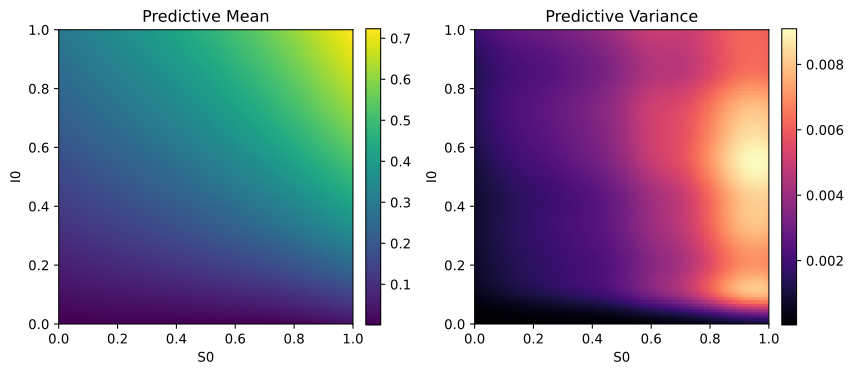
As discussed in the other resources linked at the beginning of this example, the interpretation of this example is that when there are a large amount of initital Susceptibles (\(S_0 > ~ 0.8\)) and a moderate amount of initial Infecteds (\(I_0 > ~ 0.2\)) see high variance in that some stochastic realizations result in large amounts of cumulative infections, but others do not. This is due to the high nonlinearity of an SIR model.